How Often Should You Change Your Oil? A Straight Answer for Henderson Drivers
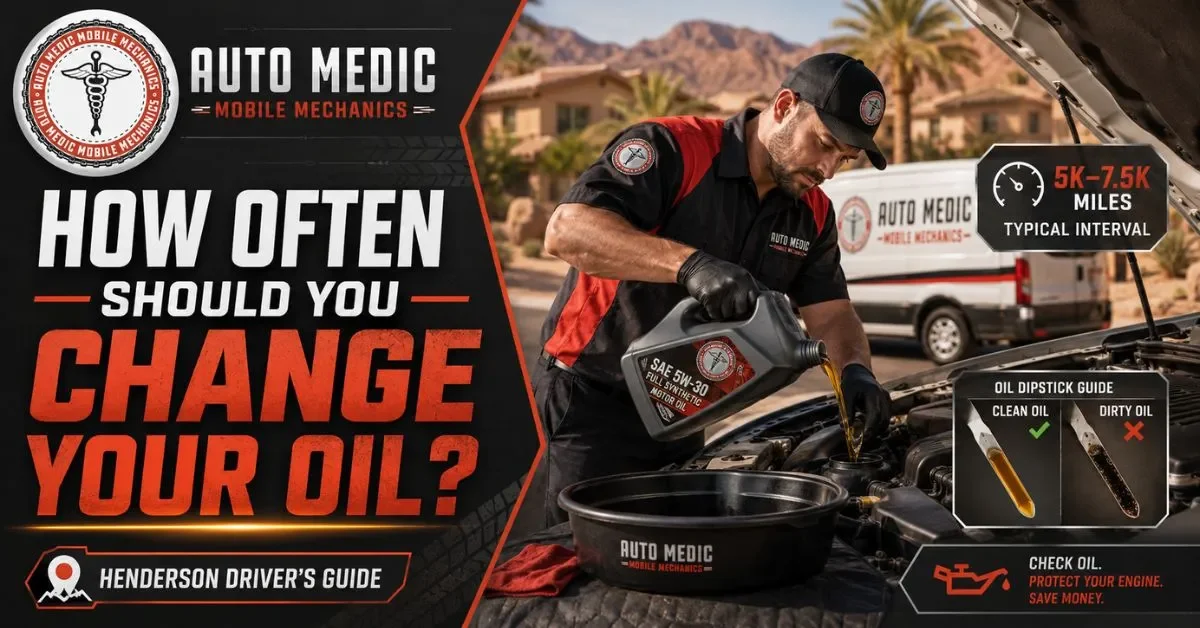
If you’ve been putting off your mobile oil change because you’re not sure whether you actually need one yet, here’s the short version: most modern vehicles need fresh oil every 5,000 to 7,500 miles, or every six months, whichever comes first. If you’re running full synthetic in a newer engine, that window can stretch to 10,000 miles depending on how and where you drive. The old 3,000-mile rule is largely outdated for today’s vehicles.
That said, the exact number depends on your specific engine, the oil type it uses, and your daily driving patterns. This guide breaks all of that down clearly, so you’re not guessing the next time that reminder light shows up.
- Most cars: oil change every 5,000–7,500 miles or every 6 months
- Full synthetic vehicles: up to 10,000 miles in some cases
- The 3,000-mile rule applies to older engines only
- Skipping too long causes sludge buildup, overheating, and accelerated engine wear
- Foreign, exotic, and fleet vehicles often have specific oil requirements. Always check your owner’s manual.
Is the 3,000-Mile Oil Change Rule Still Accurate?
No, and it hasn’t been for a while. The 3,000-mile guideline made sense when engines were less refined, oils broke down faster, and fuel systems weren’t as precise. Modern engines are built to tighter tolerances. The oil formulations used today, especially full synthetics, are engineered to handle heat, friction, and contaminants far longer than oils from 20 or 30 years ago.
Many newer vehicles also have an oil life monitoring system. This isn’t just a mileage counter; it factors in cold starts, idle time, engine load, and trip length to calculate when your specific driving pattern actually demands a change. Two people driving the same model car can get very different oil change intervals depending on how they use it.
In short: follow your vehicle’s oil life monitor or your owner’s manual interval, not the sticker on your windshield.
How Often Should You Actually Change Your Oil?
The right interval depends on three things: what oil type your engine uses, how old your vehicle is, and how you drive. Here’s a straightforward breakdown.
Vehicle / Oil Type | Recommended Interval |
Older vehicles / conventional oil | Every 3,000–5,000 miles or 3 months |
Most modern vehicles are conventional | Every 5,000–7,500 miles or 6 months |
Modern vehicles / full synthetic | Every 7,500–10,000 miles or 6–12 months |
High-performance or exotic vehicles | Varies, often 5,000–7,500 miles; check OEM specs |
Foreign vehicles (European makes) | Often 10,000–15,000 miles per manufacturer spec, but verify |
Fleet vehicles / high-mileage | Every 3,000–5,000 miles or per fleet schedule |
Expert tip: European brands like BMW, Mercedes-Benz, and Audi often specify longer intervals because their factory-fill oil is full synthetic. But longer intervals don’t mean you can skip the check oil level and condition between changes; it still matters.
In short, your owner’s manual is the most reliable source. When in doubt, a mobile mechanic can check your current oil condition in minutes without you leaving your driveway.
Conventional vs. Synthetic Oil: Does It Actually Matter?
Yes, and the difference is more practical than most people realize.
Conventional oil is refined from crude oil. It works well for older engines or vehicles that don’t run under extreme conditions. It breaks down faster under heat and typically requires more frequent changes.
Full synthetic oil is engineered at the molecular level for consistency, heat resistance, and longevity. It flows better in cold weather (relevant even in Nevada winters), protects more effectively under high engine load, and degrades more slowly. For most drivers, the slightly higher cost per change is offset by fewer changes per year.
A synthetic blend sits in between; it’s a mix of the two, often a good option for trucks, SUVs, or vehicles pulling loads.
Which Oil Does Your Car Actually Need?
The answer is in your owner’s manual. Using the wrong viscosity or grade, even if it’s synthetic, can cause problems over time. For exotic and performance vehicles, especially, manufacturers are precise about what oil their engines require, and using off-spec oil can affect both performance and warranty coverage.
In short: don’t upgrade or downgrade your oil type without checking whether your engine is built for it first.
What Actually Happens When You Skip an Oil Change?
This is the part most oil change articles skip. Here’s what’s happening inside your engine when the oil goes past its service life.
Stage 1: Oil degrades. Heat, combustion byproducts, and friction break down the additives in your oil. The oil becomes thicker and less effective at lubricating moving parts.
Stage 2: Sludge begins forming. Degraded oil mixed with contaminants starts to solidify. This sludge clogs oil passages and starves certain engine components of lubrication.
Stage 3: Parts wear faster. Without proper lubrication, metal-on-metal contact increases. You’ll notice this first as increased engine noise, then as reduced performance.
Stage 4: Overheating becomes a risk. Oil also helps transfer heat away from engine components. Old oil does this poorly, contributing to thermal stress.
Stage 5: Potential engine damage. In severe cases, prolonged neglect leads to seized lifters, scored cylinder walls, or complete engine failure repairs that cost far more than years’ worth of oil changes.
This progression isn’t a scare tactic. It’s just what happens mechanically when oil outlives its usefulness. The good news: it’s almost always preventable.
You can also read: Is Using a Mobile Mechanic a Good Idea?
Signs Your Oil Is Due Even Before the Light Comes On
Your vehicle usually tells you something is off before any warning light appears. Watch for these:
- Dark, gritty oil on the dipstick; fresh oil is amber and slightly transparent. Old oil is black and thick.
- The engine sounds louder than usual; a ticking or knocking at startup often means oil is no longer protecting surfaces properly.
- Oil pressure warning light: This is more urgent than a maintenance reminder. Don’t drive far on a low oil pressure warning.
- A burning oil smell in the cabin can indicate oil is leaking onto hot engine components.
- Exhaust smoke, bluish smoke, often means oil is burning inside the combustion chamber.
If you notice any of these, don’t wait for the scheduled interval. Get it checked.
Mobile Oil Changes in Henderson, NV: Why More Drivers Are Skipping the Shop
For most of Henderson’s working residents, the hardest part of staying on top of oil changes isn’t the cost; it’s the time. Dropping a car off, arranging a ride, and waiting around is a half-day interruption for what should be a 30-minute job.
Auto Medic Mobile Mechanics solves that directly. Their certified technicians come to your home or workplace in Henderson, bring everything needed for the job, and perform the service while you get on with your day. No waiting room. No shuttle. No rescheduling twice because the shop was backed up.
This matters especially for:
- Busy professionals and families who can’t block out shop time during the week
- Fleet managers who need vehicles serviced on-site without pulling them from rotation
- Exotic and foreign vehicle owners who want a technician experienced with their specific make
- Anyone who’s been putting it off because the logistics of a shop visit kept getting in the way
With over 25 years of industry experience and professional diagnostic equipment, Auto Medic handles oil changes for domestic, foreign, fleet, exotic, and performance vehicles, not just the straightforward stuff.
Fleet Oil Change Schedules: What’s Different
If you manage a fleet in Henderson, oil change timing works a little differently. Fleet vehicles tend to operate under harder conditions, with more frequent starts, longer daily mileage, and often heavier loads. A standard 7,500-mile consumer interval is often too loose for a commercial fleet.
A better approach for fleet maintenance:
- Establish a mileage-based schedule, typically 3,000–5,000 miles per vehicle, depending on use type
- Log oil changes per vehicle; inconsistent record-keeping is where fleet maintenance usually breaks down
- Use on-site service where possible to minimize vehicle downtime and keep your fleet on the road
- Check oil condition between changes; high-load vehicles can degrade oil faster than the odometer suggests
Auto Medic’s fleet account service is built specifically for this. They come to your location, service multiple vehicles in sequence, and keep the process off your schedule.
How to Check Your Oil Between Changes
You don’t need to wait for a reminder light to know where your oil stands. A quick dipstick check takes about 90 seconds.
- Park on level ground and turn the engine off. Wait five minutes for the oil to settle.
- Open the hood and locate the dipstick. It usually has a brightly colored handle.
- Pull it out, wipe it clean with a rag, then reinsert it fully and pull it out again.
- Check the level; it should fall between the two marks (min and max).
- Check the color; amber or light brown is fine. Black or gritty means it’s time for a change. Milky or frothy could indicate coolant contamination, which needs immediate attention.
Do this once a month or before any long drive. It’s one of the simplest, most effective things you can do for your engine’s long-term health.
In short, checking your own oil takes less time than finding parking at a shop.
Frequently Asked Questions
Frequent short trips are actually harder on oil than highway driving. Short trips don't allow the engine to fully warm up, which means condensation and fuel residue build up in the oil faster. If most of your driving is short local trips, stick closer to the 5,000-mile or 6-month interval rather than stretching to the upper limit.
A couple of hundred miles or a few extra weeks won't ruin your engine in most cases. But consistently going 2,000–3,000 miles over an interval or going more than a year between changes does add up over time. When in doubt, change it. An oil change is cheap. Engine repairs are not.
Yes. A qualified mobile mechanic carries the same oil, filters, and tools a shop would use. The difference is that they come to you. Auto Medic Mobile Mechanics uses professional-grade equipment and stocks oil for domestic, foreign, and exotic vehicles.
It genuinely lasts longer under most conditions. The molecular uniformity of full synthetics means less breakdown from heat and friction. That said, "longer" still has a limit; it's not indefinite. Check your manufacturer's spec rather than just assuming you can push it to 15,000 miles.
Those are separate systems. An oil life reminder is a scheduled maintenance prompt. A check engine light (CEL) is triggered by a sensor fault elsewhere in the vehicle. If both are on, get the CEL diagnosed first, as it can indicate issues unrelated to oil that need attention.
Not necessarily more frequent, but they're more demanding about oil specification. A Ferrari or Porsche has very specific viscosity and additive requirements. Using the wrong oil in a high-performance engine can actually do more harm than a slightly delayed change with the correct oil.
Generally, yes, especially in engines made after the early 1990s. Synthetic oil won't "clean" your engine dramatically, but it won't harm seals either, despite an old myth that it does. If your vehicle is newer and has always run conventional, switching to synthetic is usually straightforward, but verify your engine's spec first.
The Right Oil Change Interval Is the One You Actually Stick To
The honest answer is that the difference between 5,000 and 7,500 miles is far less important than actually staying consistent. Whatever interval your owner’s manual recommends, that’s your schedule. Don’t stretch it indefinitely, and don’t assume the 3,000-mile rule is still your default.
For Henderson drivers, the bigger barrier is usually finding time for a mobile oil change rather than knowing when to get one. That’s exactly the problem Auto Medic Mobile Mechanics is built to solve: certified technicians, over 25 years of experience, and service that comes to your home or workplace on your schedule.
If your oil is due or you’re not sure where you stand, skip the guesswork.
Call Auto Medic Mobile Mechanics, request a free quote, or schedule your service online today.
Recent Posts
- How Often Should You Change Your Oil? A Straight Answer for Henderson Drivers
- Brake Fluid Change Interval: How Often Should You Really Change It?
- How Long Do Car Batteries Last in Heat? A Nevada Driver’s Guide
- What Is the Most Expensive Thing to Repair on a Car? (Complete 2026 Guide)
- Is Using a Mobile Mechanic a Good Idea? Pros, Cons & Everything You Need to Know
Recent Comments
No comments to show.

Privacy & Policy | Terms & Conditions
Quick Links
2024 - 2026 Auto Medic Mobile Mechanics. All rights reserved.
Powered by  ICONIER Digital Agency