Brake Fluid Change Interval: How Often Should You Really Change It?
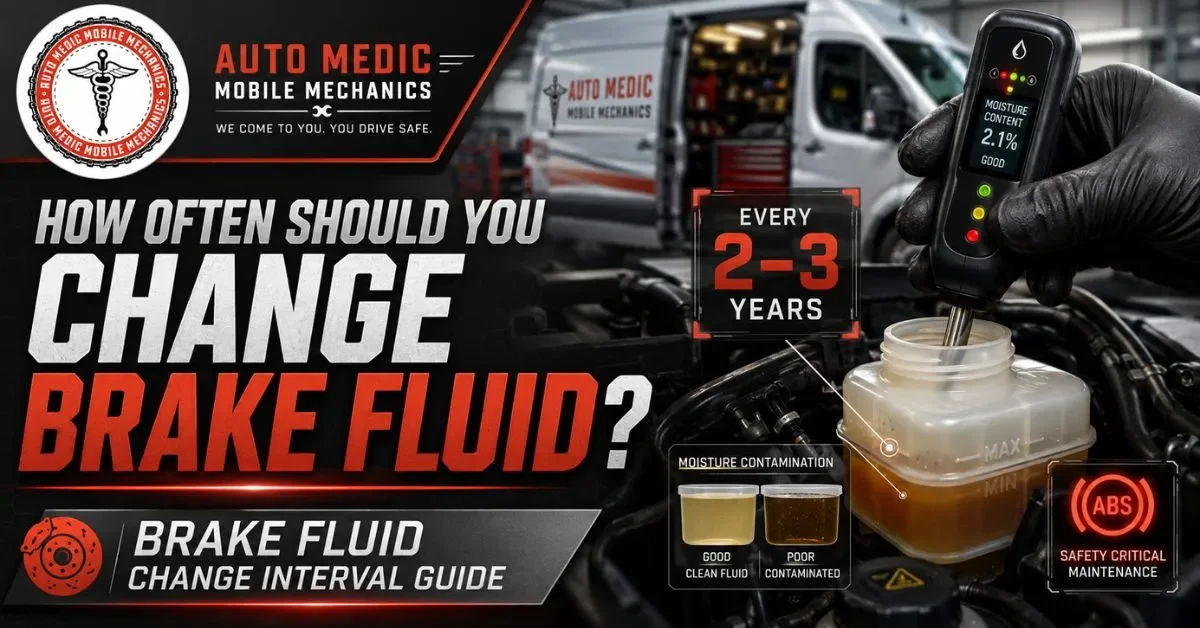
The brake fluid change interval for most passenger vehicles falls between every two and three years, or roughly 30,000 to 45,000 miles, whichever comes first. That said, the real answer depends on your specific vehicle, how you drive it, and which DOT-rated fluid it takes. Keep reading, and you’ll understand exactly why that interval exists, what happens when you ignore it, and how to tell if your fluid is already overdue.
Brake fluid rarely gets the same attention as engine oil or tire pressure, but it’s just as critical to your safety. It’s the medium that turns your foot pressure into actual stopping power, and unlike most fluids, it degrades silently over time, even if the car barely moves.
- How often: Every 2–3 years or 30,000–45,000 miles (check your owner’s manual)
- Why it matters: Brake fluid absorbs moisture and loses its boiling point, causing spongy pedals or brake fade
- Key sign it’s overdue: Pedal feels softer than usual; fluid looks dark/brown in reservoir
- DOT type: Always use what your owner’s manual specifies; never mix DOT 5 with other types
Why Brake Fluid Degrades Even When Your Car Sits Untouched
This is the part most drivers don’t know. Brake fluid is hygroscopic, meaning it actively absorbs moisture from the surrounding air. That’s actually by design; it prevents water from pooling in the calipers and causing localized rust. The problem is that absorbed moisture slowly lowers the fluid’s boiling point.
Fresh DOT 3 fluid, for example, has a dry boiling point above 400°F. After two to three years of normal use, moisture contamination can drop that threshold to around 300°F or lower. When brake fluid boils, whether from heavy use on a mountain descent or a sudden panic stop, it creates vapor bubbles in the hydraulic lines. Unlike liquid, vapor compresses. That compression is exactly why your pedal starts feeling spongy right when you need firm braking the most.
It’s also worth knowing that brake fluid doesn’t need high mileage to degrade. A car that rarely leaves the garage still has brake fluid that’s exposed to ambient humidity every time the reservoir cap sits on a warm engine bay. Time is the primary driver, not miles.
In short, brake fluid absorbs moisture over time regardless of mileage, which lowers its boiling point and can compromise stopping power.
The Brake Fluid Change Interval by Vehicle Type
There’s no universal interval that fits every car. The best starting point is always your vehicle’s owner’s manual, which will have a manufacturer-recommended schedule. Below is a practical reference based on common vehicle categories.
Vehicle Type | Typical Interval | Mileage Guide | Notes |
Most domestic cars | Every 2–3 years | ~30,000–45,000 mi | Check the owner’s manual first |
European / luxury | Every 2 years | Mileage secondary | Many require DOT 4 min |
High-performance | Every 1–2 years | Or after track use | Heat degrades fluid faster |
Fleet vehicles | Per fleet schedule | Often every 30k mi | Document all service dates |
Exotic / performance | Annually or as needed | Track-use driven | Ask a specialist |
If you’ve lost track of when it was last changed, and many people have, a certified technician can test the moisture content of your brake fluid in a few minutes using a refractometer or digital tester. That reading will tell you immediately whether you’re working with healthy fluid or fluid that’s already compromised. At Auto Medic Mobile Mechanics in Henderson, Nevada, that test happens at your front door, not in a shop waiting room.
In short: Check your owner’s manual first. For most everyday cars, every 2–3 years is a reasonable baseline. European and high-performance vehicles often need it sooner.
DOT 3 vs DOT 4 vs DOT 5.1 vs DOT 5: What the Numbers Actually Mean
DOT stands for the U.S. Department of Transportation, which sets the minimum performance standards for each grade. The number primarily indicates boiling point; higher numbers handle heat better. But the chemistry matters too.
DOT Type | Dry Boiling Pt. | Wet Boiling Pt. | Base | Typical Use |
DOT 3 | 401°F (205°C) | 284°F (140°C) | Glycol | Older domestic cars |
DOT 4 | 446°F (230°C) | 311°F (155°C) | Glycol | Most modern vehicles |
DOT 5.1 | 500°F (260°C) | 356°F (180°C) | Glycol | High-performance |
DOT 5 | 500°F (260°C) | 356°F (180°C) | Silicone | Classic/show cars: NO ABS |
The rule most people get wrong about DOT 5
DOT 5 is silicone-based and is not compatible with standard ABS systems. It also doesn’t mix with any glycol-based fluid, which covers DOT 3, 4, and 5.1. If your car didn’t come from the factory with DOT 5 fluid, and the vast majority did not, you should never put it in. Adding it to a glycol-based system can cause serious brake damage.
DOT 4 is compatible with DOT 3 systems in a pinch, but mixing them isn’t ideal for long-term performance. The cleanest approach is always to flush completely and fill with the manufacturer-specified type.
In short: Use whatever DOT rating your owner’s manual specifies. When in doubt, DOT 4 covers most modern vehicles. Never use DOT 5 unless your vehicle requires it from the factory.
Warning Signs Your Brake Fluid Needs Attention Now
You won’t always feel contaminated brake fluid right away. By the time symptoms show up, the fluid has usually been degraded for a while. These are the signals that warrant an immediate inspection:
- Soft or spongy brake pedal: The most telling sign. If your pedal travels further than usual before the brakes bite, vapor in the lines is a likely cause.
- ABS warning light: A contaminated brake system can trigger ABS codes on modern vehicles. Don’t ignore a lit ABS light.
- Dark or brownish fluid in the reservoir: Fresh fluid is usually light yellow or nearly clear. Dark fluid indicates significant contamination.
- Low fluid level without an obvious leak: Worn brake pads can naturally draw the level down, but if the pads are fine and the level is still dropping, the system needs attention.
- Burning smell after hard braking: This can indicate overheated, boiling fluid, especially on mountain roads or after aggressive driving.
If you’re experiencing any of these, it’s worth getting the fluid tested before assuming pads or calipers are the issue. Catching fluid contamination early is far less expensive than dealing with the downstream consequences.
In short, a spongy pedal, dark fluid, or a lit ABS light are the clearest signals that it’s time for a brake fluid inspection or flush.
You can also read: Is Using a Mobile Mechanic a Good Idea?
What Happens During a Brake Fluid Flush
A brake fluid flush is not the same as a simple top-off. Topping off only adds fresh fluid on top of contaminated fluid; it doesn’t address the moisture already in the system. A proper flush drains the old fluid from all four brake lines and calipers, not just the reservoir, and replaces it with fresh fluid throughout.
The process typically takes 30–60 minutes and involves bleeding each brake caliper in sequence to push all the old fluid out. When done correctly, there should be no air remaining in the lines, and the new fluid should read clean through the testing tool.
What a brake fluid flush usually costs
For most passenger vehicles, a brake fluid flush runs roughly $75–$150, depending on vehicle type, fluid grade, and labor. Performance or exotic vehicles that require specialty fluids may run higher. In many cases, the service can be bundled with an oil change or brake pad inspection to reduce total trip cost.
If you’re in Henderson, Nevada, Auto Medic Mobile Mechanics eliminates the shop visit. Certified technicians with over 25 years of experience bring professional diagnostic equipment to your home or workplace, which often means you’re spending the time you would have spent in a waiting room doing something that actually matters to you.
In short, a flush fully replaces all brake fluid in the system. Topping off doesn’t. The service takes about 30–60 minutes and typically costs $75–$150 for most vehicles.
Fleet and Multi-Vehicle Considerations
For fleet managers or anyone running multiple vehicles, brake fluid maintenance is one of the easier items to systematize, but also one of the most commonly overlooked. Vehicles that spend time idling, making frequent short trips, or sitting between uses can accumulate moisture faster than highway-driven cars.
A documented maintenance schedule that records brake fluid test results and flush dates for each vehicle makes compliance audits straightforward and reduces unexpected downtime from a brake-related failure. Auto Medic Mobile Mechanics works with fleet operators in Henderson and the broader Las Vegas area to keep service records organized and vehicles on schedule without requiring every vehicle to leave the route for a shop visit.
In short, Fleet vehicles benefit most from a documented interval schedule. Mobile service allows multiple vehicles to be serviced on-site without disrupting daily operations.
Can You Change Brake Fluid Yourself?
Technically, yes, brake fluid flushing is a DIY job. You’ll need the correct fluid, a turkey baster or hand pump to remove the old fluid from the reservoir, clear tubing, a helper to pump the brakes, and some patience. The bleeding sequence matters: most vehicles go rear-right, rear-left, front-right, and front-left, but your service manual will confirm.
Where it goes wrong is incomplete bleeding. Air in the lines is worse than old fluid. If a bubble gets trapped near a caliper, your pedal response becomes unpredictable. For everyday drivers who aren’t comfortable with brake system work, the risk of getting this wrong outweighs the cost savings.
Professional service also includes a fluid quality test before and after, which a DIY setup typically doesn’t. The test results give you actual data, moisture percentage, and effective boiling point rather than a visual guess.
In short, DIY is possible but carries meaningful risk if air gets into the lines. For most drivers, professional service offers peace of mind that’s worth the cost.
Brake Fluid Service in Henderson, Nevada: What to Know
Henderson’s climate is generally low-humidity, which is a mild advantage for brake fluid longevity compared to coastal or high-humidity areas. That said, the heat with summer temperatures regularly above 105°F puts additional thermal stress on the brake system, particularly for drivers who use the I-11 or US-95 or navigate the elevation changes coming off Boulder Highway and Lake Mead Drive.
Auto Medic Mobile Mechanics serves Henderson and the surrounding areas, handling brake fluid testing and flushes for domestic vehicles, foreign makes, fleet vehicles, and exotic or performance cars. The mobile setup means the work happens at your home, your workplace, or wherever the car is parked—no tow required, no shop wait, and no rearranging your schedule.
If you’re not sure whether you’re due for a flush, a quick test is always a reasonable first step. The data either confirms your fluid is still good, or it tells you exactly where things stand, no upselling required.
Frequently Asked Questions
For most passenger vehicles, every two to three years is the standard guidance, though some manufacturers specify every 45,000 miles. Always check your owner's manual for your vehicle's specific recommendation. If there's no record of when it was last done, a fluid quality test will tell you whether it's due now.
The most common signs are a softer-than-usual brake pedal, dark or brownish fluid in the reservoir, and a lit ABS warning light. In more severe cases, you may notice a burning smell after hard stops or noticeably longer stopping distances.
Check the owner's manual or look at the cap on the brake fluid reservoir; most vehicles stamp the required DOT rating right there. Most modern cars use DOT 3 or DOT 4. European vehicles often specify DOT 4 as a minimum. Never use DOT 5 unless your vehicle requires it from the factory, as it's silicone-based and incompatible with standard ABS systems.
Technically, yes, but it's not advisable. Contaminated fluid has a lower boiling point, which means it's more likely to create vapor in the lines during hard braking. That vapor causes a spongy pedal or, in serious cases, a temporary loss of brake feel. It's a risk that's easy and inexpensive to eliminate with a timely flush.
A professional brake fluid flush on a typical passenger car takes about 30 to 60 minutes. The time varies slightly by vehicle type and whether the technician needs to bleed an ABS module separately. Because Auto Medic Mobile Mechanics comes to you, there's no additional time lost to driving to and from a shop.
Brake fluid doesn't evaporate under normal conditions. The brake system is sealed. Fluid level drops are usually caused by worn brake pads (the calipers retract further, drawing more fluid) or a leak somewhere in the system. Contamination via moisture absorption is the primary quality concern, not volume loss.
No. A top-off only adds fresh fluid to the reservoir, which dilutes but doesn't remove the contaminated fluid throughout the lines and calipers. A flush completely drains and replaces all the fluid in the system. If your fluid is contaminated, a top-off is not a substitute for a flush.
The brake fluid change interval is simple, but easy to forget
Brake fluid change intervals exist because brake fluid degrades regardless of how much you drive. Moisture absorption is chemistry, not coincidence. Over two to three years, the fluid that’s responsible for your entire braking system quietly loses the boiling point that keeps it reliable when you need it most.
The DOT rating on your reservoir cap tells you the type. Your owner’s manual tells you the interval. A quick fluid test tells you the actual condition. And if the test says you’re due, a proper flush, not just a top-off, is the fix.
None of this has to involve a shop visit, a waiting room, or a rescheduled afternoon. If you’re in Henderson, Nevada, Auto Medic Mobile Mechanics handles brake fluid testing and flushes at your location, on your timeline, with the same professional equipment a shop would use.
Ready to Stop Guessing About Your Brake Fluid?
Auto Medic Mobile Mechanics comes to your home, office, or wherever you’re parked in Henderson, Nevada. Our certified technicians test your brake fluid on the spot and handle the flush if it’s needed.
Recent Posts
- How Often Should You Change Your Oil? A Straight Answer for Henderson Drivers
- Brake Fluid Change Interval: How Often Should You Really Change It?
- How Long Do Car Batteries Last in Heat? A Nevada Driver’s Guide
- What Is the Most Expensive Thing to Repair on a Car? (Complete 2026 Guide)
- Is Using a Mobile Mechanic a Good Idea? Pros, Cons & Everything You Need to Know
Recent Comments
No comments to show.
Privacy & Policy | Terms & Conditions
Quick Links
2024 - 2026 Auto Medic Mobile Mechanics. All rights reserved.
Powered by  ICONIER Digital Agency